Nigeria Sinotruk Local Sales Center 2025 Howo New Model
Top One World Famous Brand - Sinotruk Nigeria
Nigeria Sinotruk Local Sales Center 2025 Howo New Model
1. Why Excavators Need a Low Bed Trailer for Sale?
2. What Makes the Frame Suitable for Heavy Equipment?
3. 60T, 80T, and 100T: How the Designs Differ
4. How Should Nigerian Buyers Choose and Buy a Low Bed Trailer?
5. FAQ for Low Bed Trailer for Sale
For buyers searching for a low bed trailer for sale in Nigeria, the most important question is not simply how many tons a trailer can carry. The better question is whether the trailer is structurally designed for the machine being transported, whether the loading system is practical for repeated use, and whether the overall configuration matches the intended working conditions.
This matters particularly for excavator transportation. An excavator places concentrated loads through its tracks rather than distributing weight evenly across a trailer. Its upper structure, boom, and attachments can also affect weight distribution, while driving the machine onto the trailer creates a changing load condition before transport even begins.
For construction contractors, mining operators, quarry businesses, equipment rental companies, and heavy-equipment transporters in Nigeria, a low bed trailer manufacturers is therefore more than a steel platform. That is also why buyers should compare low bed trailer manufacturers based on engineering details instead of relying only on product names, advertised capacity, or a low quotation.
For a Nigerian buyer, the right purchasing process starts with the equipment and then works backward toward the trailer. Machine weight, machine dimensions, loading method, required working length, structural configuration, and running gear should be considered before comparing the final low bed trailer price.
A low bed trailer is most valuable when the trailer is designed around the specific requirements of heavy machinery. For excavator transport, that means the trailer must combine a suitable deck height with a structure capable of handling concentrated loading and a ramp system that makes loading practical.
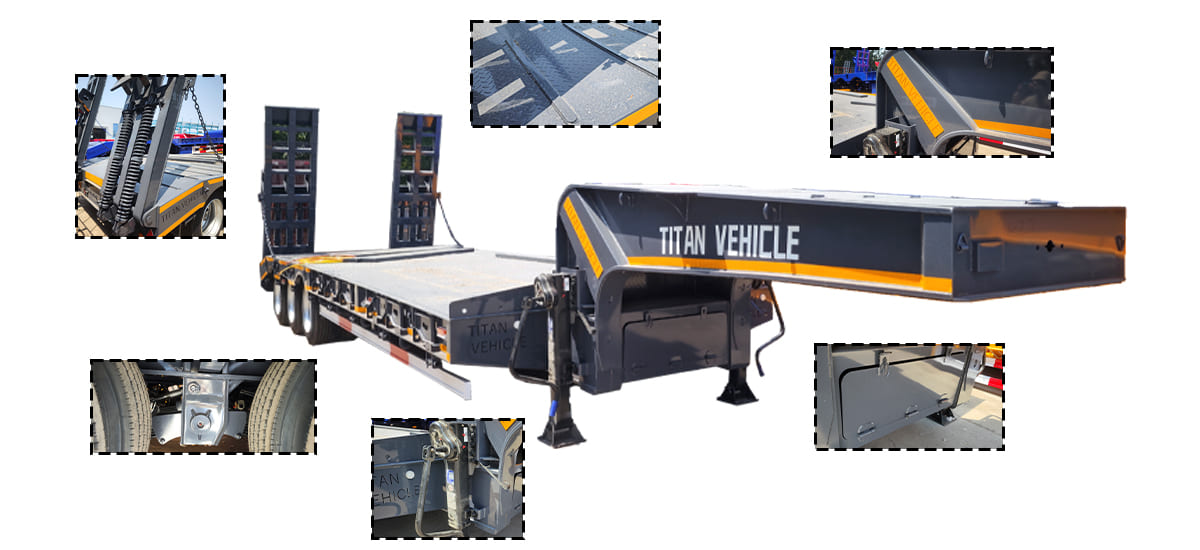 Low Bed Trailer Price Manufacturers for Sale in Nigeria
1.1 Low bed trailer construction and excavator transport
A low bed trailer price in construction is a heavy-duty semi-trailer designed to transport construction machinery on a relatively low platform, normally with ramps that allow tracked or wheeled equipment to drive onto the deck.
The lower platform helps manage the total height of the loaded transport combination. This is especially useful for excavators because the machine itself can be tall, and reducing the trailer platform height can help keep the overall transport arrangement more practical.
However, a low platform alone does not make a trailer suitable for an excavator. The machine's weight must be transferred through the deck into the structural frame, then through the suspension and axles to the road.
This is why a buyer considering a low bed trailer for sale should not evaluate the trailer only by its advertised capacity. The main beams, deck support, side members, reinforcement, suspension, axles, and ramps all need to work together.
An excavator also creates more complex loading conditions than a simple box-shaped cargo load. Its tracks create defined contact areas, while the machine's upper structure may change the center of loading depending on how it is positioned on the trailer.
The loading process itself deserves attention. When an excavator climbs the ramps, the forces acting on the trailer change as the machine moves from the ground onto the trailer. When the tracks reach the main deck, the load distribution changes again.
For Nigeria, this becomes important when a trailer is expected to move heavy equipment regularly between construction sites, road projects, quarry operations, industrial locations, or other work areas.
The low bed trailer therefore needs to be selected as an operating tool, not simply as a piece of transport equipment purchased by headline tonnage.
1.2 Why a low bed trailer for sale is different from a flatbed
A flatbed trailer is generally intended to provide a broad and versatile cargo platform. A low bed trailer price, by contrast, is built around heavy equipment loading and lower placement of machinery.
The difference becomes particularly obvious when transporting an excavator. The machine needs to climb onto the trailer, settle onto a suitable working deck, and remain properly positioned during transport.
A standard flatbed may carry certain heavy loads, but it is not automatically designed around that loading process.
This makes the dedicated structure of a low bed trailer for sale valuable. The combination of lower equipment placement and ramps is more closely aligned with the way tracked machinery is moved.
For buyers in Nigeria, this distinction matters because an excavator trailer may be used frequently rather than occasionally. A trailer that is easy to load and correctly matched to the machine can be more useful over repeated transport cycles than a general-purpose trailer with a superficially similar deck.
This is also why search terms can create confusion. A buyer may find lowbed, low loader, lowboy, and low flatbed listings that use overlapping terminology. The actual frame and loading specification matters more than the product title.
1.3 Why loading ramps are part of the engineering
A heavy low bed trailer can only perform its intended job if the excavator can be loaded and unloaded efficiently.
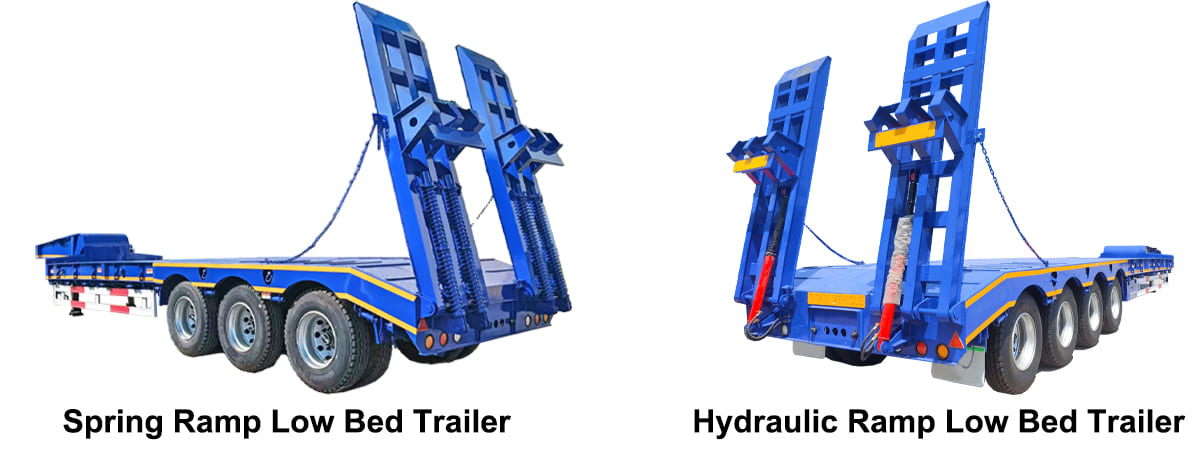
The supplied 60 ton and 80 ton configurations use double-spring ramps made from high-strength plate and welded into a box-type structure with four vertical plates. The design is specified so that one worker can raise and lower the ramps.
The 100 ton model also uses double-spring ramps, with the ramp structure made from high-strength plate by butt welding.
The significance of this feature is practical. The ramp supports the machine during one of the most sensitive moments of the operating cycle: when the excavator transitions from the road surface to the trailer deck.
A buyer evaluating a low bed trailer for sale should therefore consider whether the ramps are robust, practical to operate, and appropriately integrated into the overall trailer design.
For repeated transport work in Nigeria, loading efficiency can affect how easily equipment can be moved from one project to another. A strong frame is important, but daily usability is also part of the product's value.
 Low Bed Trailer Price Manufacturers for Sale in Nigeria
1.4 Why low bed trailer height and deck design matter
The supplied configurations have an overall height of 1,700 mm and use a 5 mm-thick patterned steel deck.
These figures should be understood in context. The trailer's height is only part of the final transport height because the excavator itself adds significant height above the deck.
The purpose of the low platform is therefore to help manage the loaded combination rather than to solve the entire height problem by itself.
The patterned deck provides the working surface for the equipment, but it should not be confused with the complete structural capacity of the trailer. The deck transfers the machine load into the supporting frame beneath it.
This distinction is important when comparing low bed trailer manufacturers. A buyer who looks only at deck thickness may miss more important structural factors such as main beam geometry, web thickness, flange dimensions, side reinforcement, and suspension design.
The practical buying question is simple: does the complete deck and frame arrangement match the machine that will actually be transported?
A heavy-equipment low bed trailer for sale needs more than thick steel. Its structural materials, beam geometry, side reinforcement, suspension, and running gear must form a coordinated load-bearing system.
2.1 High-strength steel and structural design
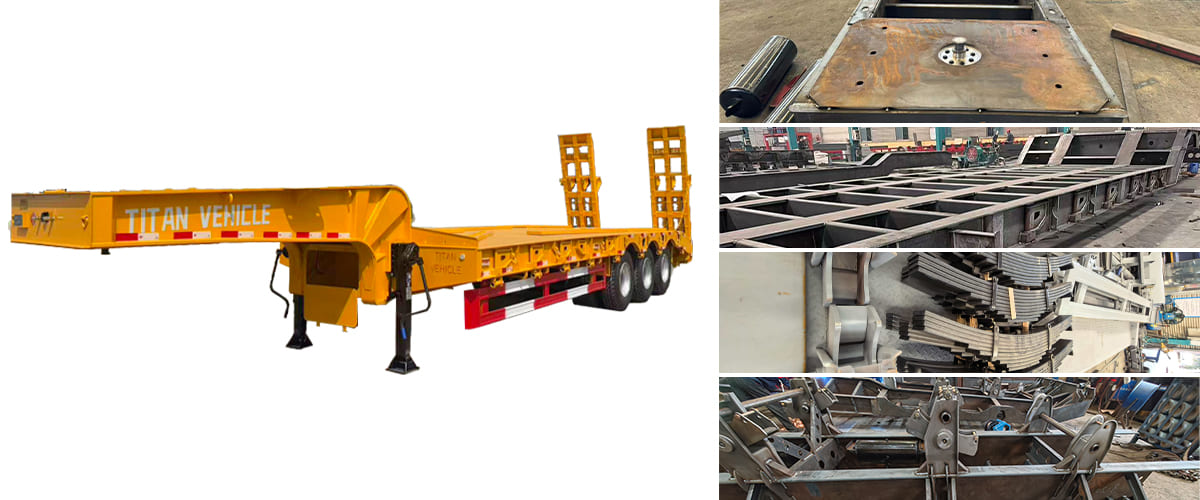
The supplied main beams are made from Q460C high-strength manganese steel, also identified in the product information as HG60 steel. The stated characteristics include high strength, good toughness, fatigue resistance, and resistance to jolting.
These properties are relevant to heavy machinery transportation because the low bed trailer manufacturers is exposed to repeated load cycles rather than one isolated static event.
An excavator may be loaded, transported, unloaded, and transported again. During that process, the trailer structure experiences repeated stresses from the machine itself and from changes in the road surface.
The steel grade therefore matters, but steel grade alone does not define the performance of a heavy trailer. The geometry of the structural sections is equally important.
For example, the supplied 60-ton model uses a 500 mm-high main longitudinal beam with 20 mm-thick upper and lower flanges, each 200 mm wide, and a 12 mm-thick web.
This gives the buyer useful information about the actual frame rather than a generic description such as “reinforced heavy-duty steel.”
For low bed trailer manufacturers, being able to explain both the material and the structural section is more useful to a B2B buyer than simply advertising a high steel grade.
2.2 Why beam height, flange width, and web thickness matter
The main longitudinal beams are among the principal load-bearing elements of the low bed trailer for sale.
The geometry of a beam affects how it handles bending and distributes load. The web and flanges perform different structural roles, so the buyer should evaluate them as a complete cross-section.
The supplied products show this clearly. The 60-ton model uses a 500 mm beam height and 12 mm web, while the higher-duty models use a 550 mm beam with thicker webs.
The 100-ton configuration further increases the flange width to 230 mm and the web thickness to 16 mm.
These changes demonstrate why trailer capacity should not be treated as a label disconnected from frame construction.
When comparing a low bed trailer for sale, a buyer can ask a straightforward question: what structural changes has the manufacturer made to support the higher intended duty?
A supplier that can answer that question clearly is providing more useful engineering information than one that simply repeats a payload number.
2.3 Why side beams and reinforcement matter
The frame is not supported only by the central longitudinal beams.
The supplied trailers use welded I-section manganese steel side beams measuring 300 mm high and 140 mm wide. Their detailed section thickness changes according to the configuration.
The 60-ton model uses 6 mm manganese plate for inclined side supports, formed by bending and positioned approximately every 500 mm.
The heavier configurations use I-shaped high-strength welded reinforcement. This helps create repeated structural support points along the trailer rather than leaving large sections of the side structure unsupported.
That matters because excavator loads are not always perfectly centered. The tracks occupy particular positions on the deck, while the machine's mass may not be distributed evenly from front to rear.
The side structure therefore contributes to the overall rigidity of the frame.
For a buyer comparing low bed trailer manufacturers, this is one reason it is useful to ask for details about side-member construction rather than focusing entirely on the central beam.
2.4 Why suspension, axles, and running gear are part of the structure
The frame eventually transfers its load into the suspension, axles, tires, and road surface.
The supplied 60-ton and 80-ton configurations use 10-piece reinforced leaf springs, specified as 16 mm thick and 900 mm wide, together with 10 mm-thick reinforced suspension and a 70 mm center shaft.
The 100-ton configuration uses 10-piece reinforced leaf springs, specified as 16 mm thick and 120 mm wide, along with 10 mm-thick reinforced suspension and 120 mm width.
The axle configuration also changes between models, with the three-axle products using 16-ton TITAN axles and the heavy four-axle configuration using four of the same axle type.
These components should not be considered independently. The trailer's running gear needs to be appropriate for the intended frame and load.
The tire specification is also part of the complete configuration. The supplied products use 12R22.5 tires, with the 100-ton version using 16 tires corresponding to its four-axle arrangement.
 Low Bed Trailer Price Manufacturers for Sale in Nigeria
2.5 Why practical accessories also matter
The supplied configurations include 28-ton landing gear, demonstrating that the low bed trailer price is designed not only around its rolling operation but also around coupling and parking.
The 60-ton and 80-ton models include one toolbox and one spare-tire rack, while the 100-ton model includes two toolboxes and one spare-tire rack.
These features do not determine the low bed trailer's primary structural strength, but they improve the practical completeness of the equipment.
The finishing system is specified as polyurethane paint.
For buyers in Nigeria, these details should be recorded in the final quotation so there is no ambiguity over what is included in the purchased trailer.
2.6 Why material selection should not become a marketing shortcut
High-strength steel is useful only when it is correctly applied within a sound structural design.
A supplier may promote a certain steel grade, but the buyer should still ask where that material is used and how it relates to the beam geometry and reinforcement.
The supplied products use Q460C/HG60 in the main structural system, while the heavier designs also identify T700 in relevant high-strength components.
The important point is not that one material name sounds more impressive than another. What matters is the combination of material, dimensions, welding, structural geometry, and intended application.
A professional low bed trailer manufacturer should therefore discuss steel as part of the complete design rather than use the material grade as a substitute for engineering explanation.
The three configurations should be compared in one dedicated section because their structural differences directly affect the choice. Outside this section, it is more useful to focus on the common engineering principles and purchase logic rather than repeatedly listing all three sets of numbers.
| Configuration | Overall dimensions | Main beam structure | Axle arrangement | Main application focus |
|---|---|---|---|---|
| 60-ton low bed trailer | 13,000 × 3,000 × 1,700 mm | 500 mm high; 20 mm × 200 mm flanges; 12 mm web | 3 × 16-ton TITAN axles | Excavator transportation |
| 80-ton heavy low bed trailer | 13,000 × 3,000 × 1,700 mm | 550 mm high; 20 mm × 200 mm flanges; 14 mm web | 3 × 16-ton TITAN axles | Heavier excavator transportation |
| 100-ton heavy low bed trailer | 15,800 × 3,000 × 1,700 mm | 550 mm high; 20 mm × 230 mm flanges; 16 mm web | 4 × 16-ton TITAN axles | Heavy-equipment transport |
3.1 What the comparison means for Nigeria buyers
The three models represent different solutions rather than a simple good-better-best hierarchy.
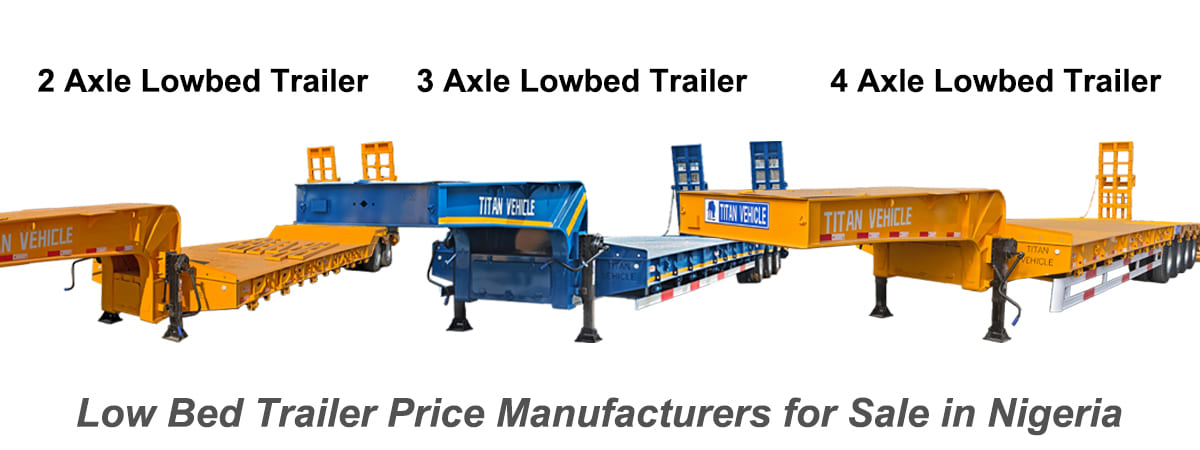
The 60-ton low bed trailer model is designed around excavator transportation within its stated capacity. The 80-ton model offers a heavier structural arrangement while retaining the shorter overall frame. The 100-ton model moves to a longer four-axle platform with a larger structural section.
For a buyer in Nigeria, the correct decision should be based on the actual equipment and transport application.
A business that only needs the capabilities of the 60-ton model may have little reason to purchase the 100-ton unit. On the other hand, a buyer transporting substantially heavier machinery or requiring the longer working area may have a clear reason to move to the larger configuration.
This is also where comparing low bed trailer manufacturers becomes more meaningful. A good supplier should be able to explain the structural reasons behind the different configurations rather than treating capacity as a simple number on a model name.
The most reliable purchasing strategy is to begin with the machine, then evaluate the trailer's working conditions, structure, practical features, and final commercial quotation.
4.1 Start with the actual machine
The first thing a buyer should establish is the real equipment requirement.
Confirm the excavator's operating weight, dimensions, track width, attachments, and loading configuration. If the trailer will carry multiple types of equipment, identify the heaviest and largest machine that will realistically be transported. This prevents the common mistake of selecting a trailer based on a generic capacity number.
For Nigeria, this is particularly useful for contractors and equipment rental businesses because a single trailer may serve multiple construction projects over time. The low bed trailer for sale should be selected based on the machines that will actually use it, not on what looks strongest in an online catalog.
4.2 Consider how frequently the trailer will be used
Transport frequency influences the importance of practical features.
A company that moves excavators regularly may place greater value on ramp operation, structural durability, and easy access to equipment through the supplied toolboxes and spare-tire rack. A company that only moves equipment occasionally may have a different commercial priority.
The key is to identify how the trailer will function inside the business. A low bed trailer for sale should therefore be evaluated as part of a fleet's operating workflow rather than as an isolated capital purchase.
4.3 Evaluate the working environment realistically
There is no need to invent local regulations or unsupported road statistics to make a trailer relevant to Nigeria.
The practical fact is that operating conditions can vary between construction projects, quarries, industrial locations, and inter-site transportation. A buyer should therefore tell the manufacturer where and how the low bed trailer price will work.
The supplied structural design specifically emphasizes strength, toughness, fatigue resistance, and resistance to jolting in the main structural material. These characteristics are relevant to repeated heavy-duty work, but they should not be transformed into unsupported claims about a guaranteed service life on every route. The responsible approach is to match the equipment to the actual application.
4.4 Check loading and unloading before checking the quotation
A low bed trailer price is used repeatedly. Loading should therefore be part of the purchase decision.
The supplied double-spring ramps are an important feature because they are designed for machinery loading. The 60-ton and 80-ton designs use high-strength box-type construction with four vertical plates and are specified so that one worker can raise and lower the ramps. This is a practical benefit for a fleet operator who does not want each loading operation to become a complex task. A buyer should ask the supplier to explain how the ramp system is constructed and how it integrates with the trailer frame.
4.5 Compare the structural specification line by line
When comparing low bed trailer manufacturers, buyers should request the exact specification of the proposed trailer.
The comparison should include the main beam material, beam height, flange dimensions, web thickness, side-beam design, reinforcement, deck thickness, suspension, axles, tires, ramps, landing gear, dimensions, and included accessories.
The purpose is to make sure that two competing quotations are actually offering equivalent products. This is particularly important when the difference in low bed trailer price is significant. A low quotation can be attractive, but the buyer should first determine whether the supplier is quoting the same structural configuration.
4.6 How to evaluate low bed trailer price
The correct low bed trailer price is the price of the required specification, not simply the lowest price on a search page.
A trailer's quotation can change according to its capacity, frame structure, material, dimensions, axle count, suspension, ramp design, tires, accessories, and other specified equipment. For a buyer in Nigeria, a useful purchasing method is to give several low bed trailer manufacturers the same specification and then compare the quotations. That creates a much cleaner commercial comparison than asking different suppliers for their “cheapest low bed.”
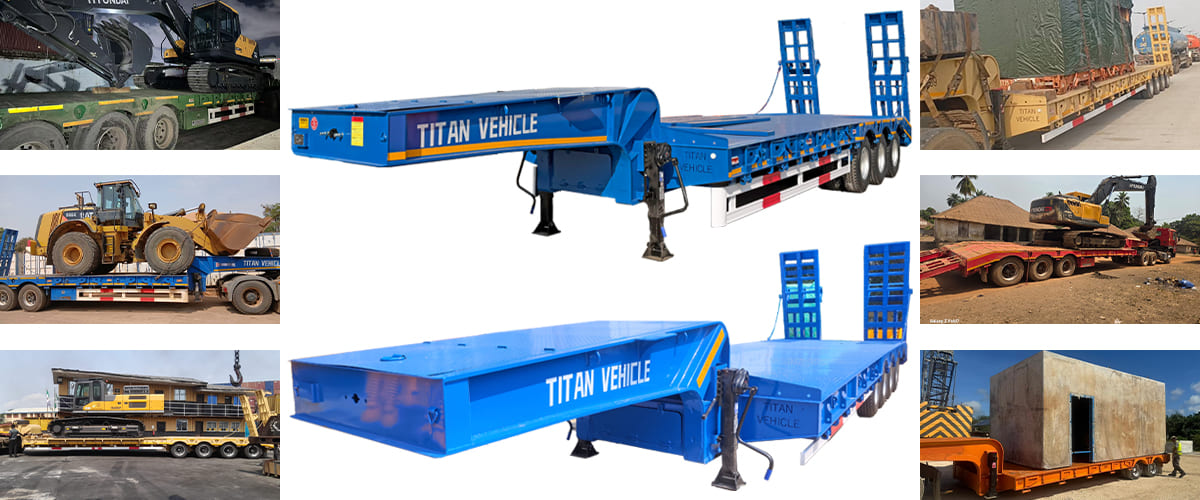 Low Bed Trailer Price Manufacturers for Sale in Nigeria
4.7 What should be included in the final quotation?
The quotation should clearly identify the exact trailer being supplied.
At minimum, it should state the overall dimensions, intended capacity, structural materials, main beam design, axle arrangement, suspension, tires, ramp configuration, deck construction, landing gear, painting system, and included accessories. The supplied configurations also provide examples of details that should be recorded clearly. The 60-ton and 80-ton versions include one toolbox and one spare-tire rack, while the 100-ton version includes two toolboxes and one spare-tire rack.
4.8 Why manufacturing capability matters
A trailer with a strong specification still depends on manufacturing quality.
The products described here use welded structural components for the main frame, side structures, reinforcement, and ramp assemblies. That means fabrication accuracy, welding, frame assembly, and final installation all influence the finished low bed trailer for sale. A buyer evaluating low bed trailer manufacturers should therefore consider whether the supplier has the manufacturing capability to repeatedly produce the quoted structural design.
The manufacturer's ability to discuss the engineering in practical terms is also useful. A supplier should be able to explain why a 60-ton, 80-ton, and 100-ton configuration use different frame sections rather than presenting them as the same trailer with different payload labels.
5.1 How much does a low bed cost?
A low bed trailer price depends on the trailer's capacity, dimensions, structural design, axles, suspension, ramps, materials, and included equipment. The exact price should be based on the specification required for the customer's machinery.
5.2 What are the dimensions of a 40-foot low bed trailer?
There is no single universal dimension for every 40-foot low bed. In the supplied range, the 60-ton and 80-ton models are 13,000 x 3,000 x 1,700 mm, while the 100-ton model is 15,800 x 3,000 x 1,700 mm.
5.3 What is the difference between a lowboy trailer and a lowbed trailer?
The two terms can overlap depending on the market and supplier. For B2B purchasing, the actual frame, deck, axle configuration, dimensions, and loading system are more important than the terminology.
5.4 How many axles does a low-bed trailer have?
It depends on the configuration. The supplied 60-ton and 80-ton trailers use three 16-ton TITAN axles, while the 100-ton trailer uses four 16-ton TITAN axles.
5.5 What is the difference between a lowbed and a flatbed?
A lowbed is designed around heavy machinery loading and a relatively low platform, while a flatbed is generally a more versatile cargo platform. For excavator transportation, the lowbed arrangement is more directly matched to the loading requirements.
5.6 Which low bed trailer is best for Nigeria?
There is no single best configuration for every application in Nigeria. The choice should be based on the actual excavator weight and dimensions, required working length, loading method, and intended transport duty.
5.7 How do I compare low bed trailer manufacturers?
Compare the exact frame, steel, beam dimensions, reinforcement, axles, suspension, ramps, deck, dimensions, and included equipment before comparing price. This allows buyers to compare low bed trailer manufacturers on actual engineering rather than advertising language.
Add: PLOT 3, OBA, AKRAN AVENUE, IKEJA, LAGOS